Grow Your Audience and Get More Leads on Social Media
Eight practical tips for small business owners who want real growth on social media without wasting time or money.

Posted at
Posted on
Social Media
As of April 2026, 5.79 billion people use social media worldwide, roughly 70% of the global population. Your potential clients are almost certainly scrolling right now. The question is whether they are finding you.
Social media marketing for small businesses does not require a large budget or a full time marketing team. What it requires is a clear strategy, a sustainable posting habit, and the right mix of organic content and paid promotion. These eight tips cover both. Work through them in order, or start with the ones that apply most to where you are right now.
These eight tips will show you exactly where to start.
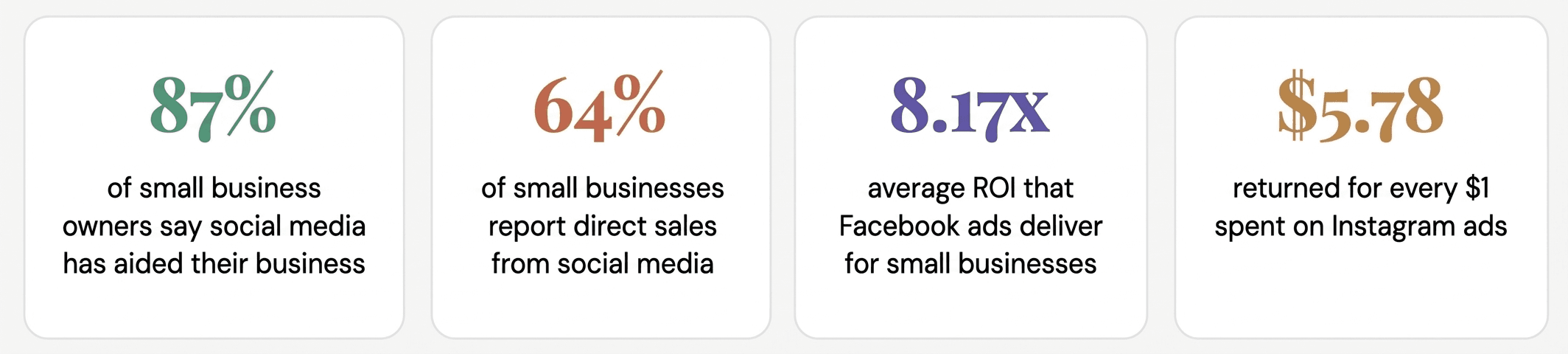
Sources: BusinessDIT, Gitnux
Organic Growth Strategies To Build Real Momentum
Organic social media is the foundation. It builds the trust and credibility that make everything else, including paid ads, work better. Start here before you spend a dollar.
1. Post on a Consistent Schedule You Can Sustain
The single biggest mistake small businesses make on social media is posting in bursts and then disappearing for weeks. Every major platform algorithm rewards accounts that show up regularly, and so do potential followers. You do not need to post every day. You need to post on a schedule you can actually keep.
Pick two or three days a week, decide on your content format ahead of time, and stick to it. Consistency beats frequency. A business that posts three times a week for six months will almost always outperform one that posts daily for three weeks and then stops.
2. Lead With Value in Every Post
People follow accounts that give them something useful. Before you publish anything, ask yourself: would someone save or share this? Content that teaches a quick tip, answers a common question, or offers a behind the scenes look at your work consistently outperforms promotional posts.
A practical guideline is the 80/20 split: 80% of your content should educate, entertain, or inspire, and 20% can be promotional. If every post is a sales pitch, people stop paying attention. If every post gives them something worth keeping, they start looking forward to what you share next.
3. Use Short Form Video to Reach More People
Instagram Reels, TikTok clips, and YouTube Shorts currently receive preferential treatment in every major platform algorithm. According to 2026 data from Buffer, short form video generates 2.5x more engagement than long form content across platforms. On Instagram specifically, Reels reach 2.25x more people outside your existing audience compared to standard photo posts and deliver a 112% higher engagement rate.
You do not need studio quality production to make this work. Authenticity consistently outperforms polish in short form video. A 30 second clip filmed on your phone, showing how you solve a problem your clients face, will perform better than a heavily produced ad that looks like every other ad on the feed.
4. Engage Actively to Grow Your Community Faster
Social media is a two way conversation. Responding to every comment, answering DMs promptly, and engaging with other accounts in your niche signals to algorithms that your account is active and worth promoting. It also builds genuine relationships that convert into clients over time.
Accounts that treat social media as a one way broadcast channel miss the biggest organic growth lever available to them. Spend 15 minutes a day responding and engaging as it compounds quickly.
If managing community engagement consistently feels like too much to take on alongside running your business, that is exactly what social media management is designed to handle.
Paid Social Strategies To Make Every Dollar Count
Organic content builds your audience. Paid promotion accelerates it. These four tips will help you spend smarter and waste less.
5. Boost Your Best Organic Content Before You Spend
The most common paid social mistake is creating a brand new ad from scratch and putting money behind it before you know whether the message resonates. There is a better way to start.
Look at your last 30 days of organic posts and find the one that got the most engagement like more saves, shares, or comments than usual. That is your first ad. Boosting content that already proved itself to a real audience is a far smarter starting point than guessing. We tell clients to check their existing feed before they open the Ads Manager, and nine times out of ten, the post worth boosting is already there. It just needs the budget behind it.
6. Target Precisely Before You Put Money Behind an Ad
The biggest advantage paid social has over almost every other marketing channel is the ability to define exactly who sees your content down to location, age, interests, behaviors, and even life events. A small budget goes much further when your ad is shown to 2,000 highly qualified people rather than 20,000 people who will never need what you offer.
Build your target audience in the Ads Manager before you spend anything. If your business serves a specific neighborhood, city, or region, layer geographic targeting with interest and behavior data. For more on building a presence that attracts the right local audience, the approach we outline in hyperlocal targeting strategies applies directly to how you structure your paid social audiences as well.
7. Use Retargeting to Convert Warm Leads
People who have already visited your website, watched your videos, or engaged with your social profile are far more likely to become paying clients than cold audiences. According to DemandSage's 2026 retargeting data, retargeted visitors are 70% more likely to convert than those seeing your content for the first time.
Retargeting ads show your content specifically to these warm leads: people who have already shown interest, and they consistently deliver the best return on ad spend available to small businesses. Setting up a Meta Pixel on your website is free and takes about 20 minutes, but it unlocks one of the most powerful targeting tools available to you. Do it before you run your first paid campaign.
8. Give Every Ad One Job
Paid social ads that try to do too many things at once (visit the website, follow the page, and call for a consultation) tend to accomplish none of them well. Every ad needs one job.
Pick a single action you want the viewer to take, make it unmistakably clear, and remove everything that distracts from it. The most effective calls to action for local service business lead generation are typically "Book a free consultation," "Download the guide," or "Get a quote today." Keep it simple, keep it specific.
Organic and Paid Work Best Together
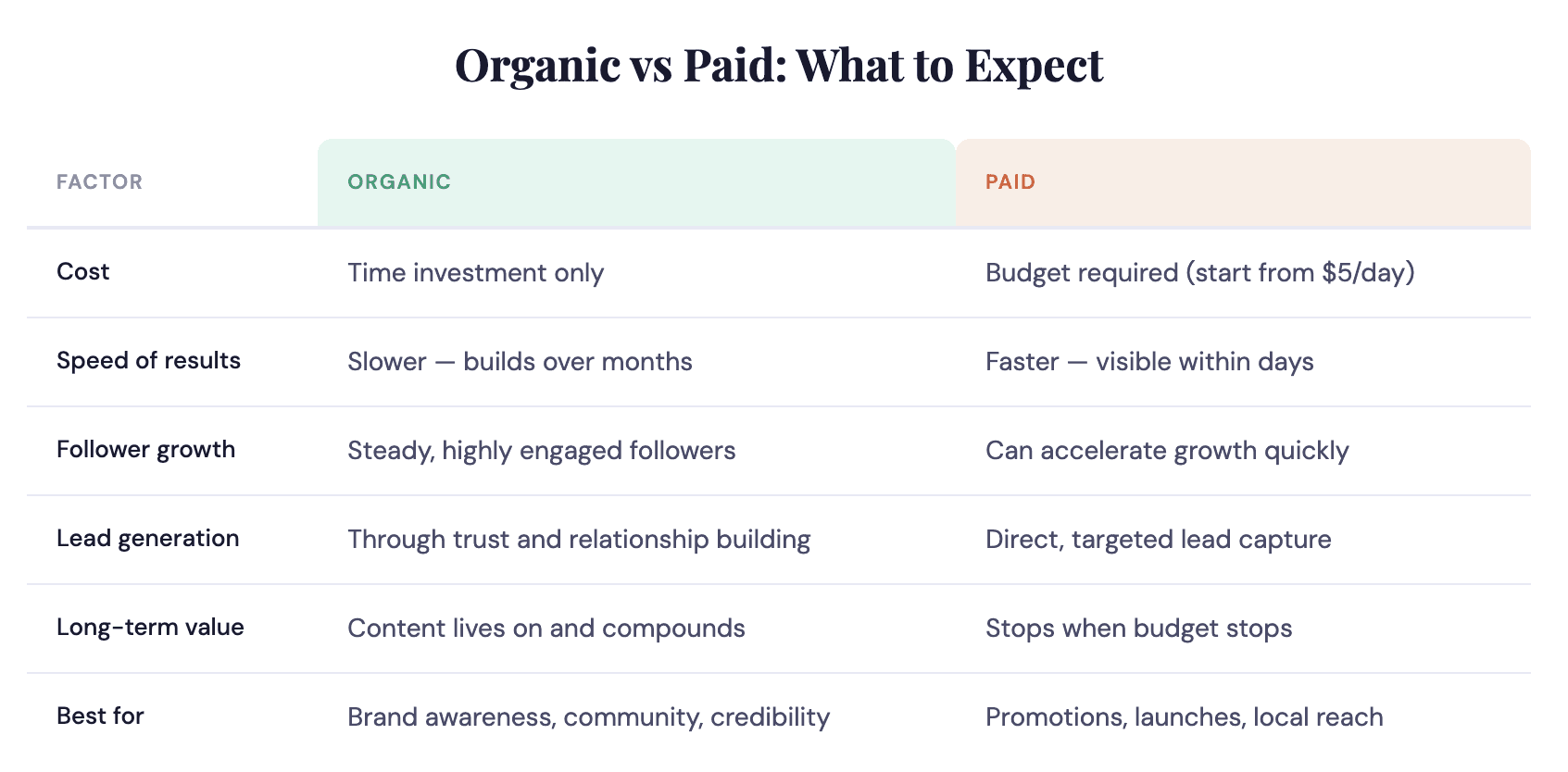
Here is the most important thing to understand about social media marketing for small businesses: organic and paid are not competing strategies. They are complementary ones. Organic content builds the trust that makes paid ads convert. Paid ads accelerate the reach that helps your organic content find new audiences.
Start with one or two tips from each section above. Stay consistent for 60 to 90 days. Local service businesses that publish targeted content on a regular basis typically see a measurable increase in inbound inquiries within that window. Let the data guide your next move from there.
You do not have to figure all of this out on your own. If you want a strategy built around your specific business, take a look at the digital marketing services we offer and see what fits where you are right now.
Frequently Asked Questions
How often should a small business post on social media?
Two to four times per week is a realistic and effective frequency for most small businesses. The most important factor is consistency: a sustainable schedule you can maintain for months will outperform a heavy posting sprint that burns you out. Pick a cadence that fits your workflow and stick to it.
What is the best social media platform for small businesses?
It depends on where your clients already spend their time. For most local service businesses, Instagram and Facebook offer the best combination of reach, targeting capability, and organic discoverability. If your audience skews younger or you are comfortable with video, TikTok is worth adding. Start with one or two platforms and go deep before expanding.
How much should a small business spend on social media advertising?
You can start with as little as $5 to $10 per day when you are testing content and audiences. The goal early on is not to scale spend but rather to understand what messaging and audiences respond. Once you have a proven ad that delivers results, increasing the budget is a simple decision. Precision matters more than volume at the start.
What types of content perform best on social media for small businesses?
Short form video consistently delivers the widest reach, especially on Instagram and TikTok. Carousel posts tend to earn the highest engagement rates per impression. Educational content (tips, how to guides, and answers to common questions) generates the most saves and shares, which signals to algorithms that your content is worth promoting to new audiences.
How do I know if my social media marketing is working?
Track three metrics that map directly to business outcomes: reach (are more people seeing your content each month), engagement (are people saving, sharing, and commenting), and leads generated (are people contacting you through social). Follower count is a lagging indicator. Focus on the numbers that connect to actual client inquiries rather than vanity metrics.
Not sure where to start?
Let's talk through what would actually make sense for your business. Contact me.